NJ Soil Isn't One Thing
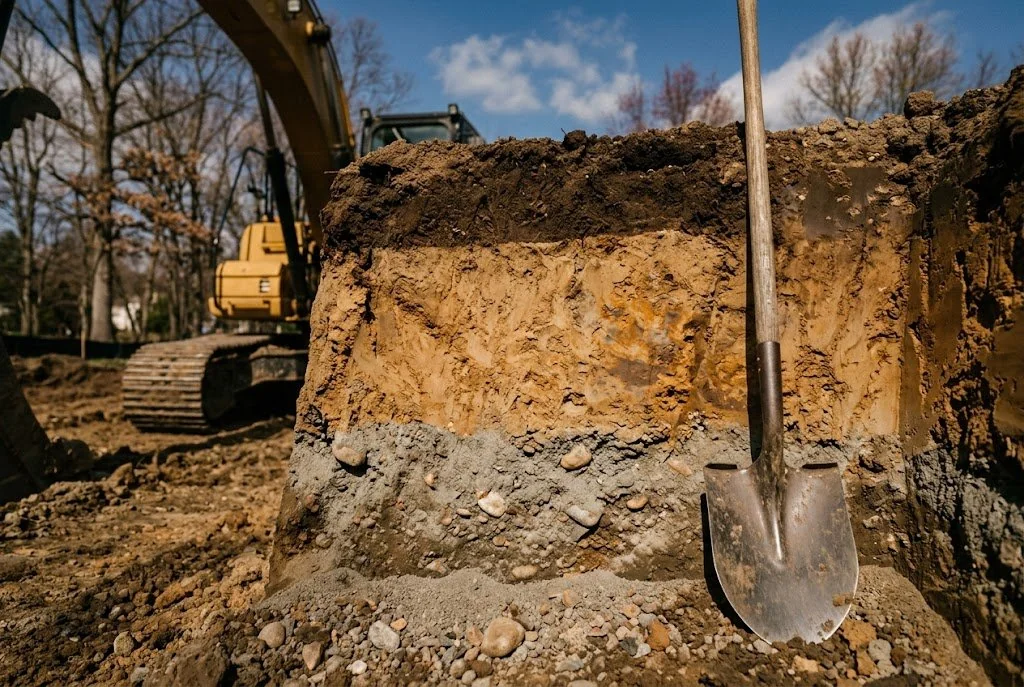
New Jersey is geologically diverse for such a small state. The northern part of the state — the Highlands and the Piedmont — sits on bedrock with thin rocky soil overlay. The Inner Coastal Plain (most of Central and South NJ) has deep sandy and silty soils with patches of clay. The Pine Barrens have remarkable sandy soils that drain almost too well. And almost every developed area has been heavily disturbed by construction history, meaning what's actually under a property in 2026 is often a mix of native soil, decades-old fill, and whatever the last grading job left behind.
For excavation work, the soil dictates almost everything that happens after we break ground. Knowing roughly what you have before we start saves time and rules out cost surprises.
The Five Soil Types You'll Encounter in Central NJ
1. Sandy Soil
Sandy soil dominates large parts of Central and South Jersey. It's loose, granular, drains fast, and digs quickly. The good and bad of sandy soil for excavation:
- Good: Easy digging, fast progress, equipment doesn't get stuck
- Bad: Walls don't hold shape — sandy soil collapses easily without shoring
- Good: Drains beautifully, great for septic leach fields and dry wells
- Bad: Too sandy for septic without engineering — water passes through faster than the leach field can treat
Sandy soil excavation tends to come in at the lower end of the cost range because it digs fast and disposal is cheap. But you may need extra shoring in deeper digs (basement-depth and below) to keep walls from collapsing during the work.
2. Clay Soil
Clay shows up in patches throughout Central NJ, particularly in low-lying areas and along stream beds. It's dense, sticky, and holds water for days after rain.
- Good: Walls hold their shape during excavation — much less shoring needed
- Bad: Slow to dig, equipment uses more fuel, day's progress is shorter
- Bad: Doesn't drain — terrible for septic systems and standard French drains
- Good: Excellent for foundation bearing capacity if it's well-compacted
Clay soil drainage problems are why so many NJ homes have wet basements. Water that should percolate down into the soil instead pools at the foundation because the clay won't accept it. The fix isn't usually to "drain the basement" — it's to install drainage that moves water around the property without relying on clay percolation.
3. Rocky / Bony Soil
The northern and western parts of NJ have soils with significant rock content — anywhere from cobble-sized stones scattered through dirt to actual bedrock at shallow depth. Rocky soil is the wildcard of excavation pricing.
- Bad: Slow digging, equipment wear, sometimes requires breaking with hammers or breakers
- Bad: Disposal of large rocks is its own logistics problem
- Good: Excellent foundation bearing and drainage
- Bad: Hitting bedrock at unexpected depth changes the project entirely — sometimes the only solution is rock breaking, blasting (rarely permitted in residential), or redesigning the foundation depth
If you're in an area with rocky soil, we always recommend a test pit or two before committing to a full project. Knowing whether you have rock at 4 feet or rock at 8 feet changes everything.
4. Loamy / Silty Soil
The "ideal" soil for most purposes — a balanced mix of sand, silt, and clay. Drains well but holds enough moisture for landscaping. Digs cleanly without collapsing. Found in agricultural areas and many suburban developments throughout Monmouth and Middlesex County.
- Good: Workable, predictable, well-suited for almost any project
- Good: Septic systems generally pass perc tests
- Good: Foundations bear well, drainage is reliable
- Neutral: Cost of excavation is at or near average — no big surprises either direction
5. Fill / Disturbed Soil
This is what most "older" suburban properties actually have, particularly anything graded for development in the 1950s-1980s. The original soil profile was disturbed during construction. What's there now is some mix of native soil, imported fill, construction debris, and decades of settling.
- Variable: No way to predict what we'll find without digging or testing
- Bad: May contain debris (concrete chunks, rebar, old plastic, sometimes worse)
- Bad: Settles inconsistently — uneven foundation bearing, drainage problems
- Bad: Sometimes contains contamination from old fuel tanks, lead paint, or other historical issues
Fill is the soil type most likely to surprise everyone. We've found everything from buried cars to old oil tanks to entire concrete slabs from previous structures. Test pits matter more here than anywhere else.
How to Tell What You Have
You don't need a soil scientist to start. Some simple observations:
- Squeeze test: Take a handful of moist soil. Squeeze it. Sandy stays loose, clay holds shape stiffly, loam crumbles when poked.
- Drainage test: Dig a 1-foot hole, fill with water, time how long to drain. Under 30 minutes = sandy. 1-2 hours = loam. Over 4 hours = clay or compacted.
- Look at neighboring construction: If neighbors have rocky basements, you probably do too. If their basements are wet, that's a clue about drainage and soil type.
- NRCS soil survey maps (free online via the USDA Web Soil Survey tool) will tell you the official soil classification for your specific parcel. Imperfect but a useful starting point.
For real accuracy, we do test pits — small exploratory digs in 2-3 spots on the property to see exactly what's there at depth before we commit to a project plan.
Why This Matters for Specific Projects
For Foundations
Bearing capacity drives the foundation design. Clay and rock = strong bearing, simple footings work. Sand without rock = needs wider footings or deeper foundation. Fill = often needs to be over-excavated and replaced with engineered fill before the foundation goes in.
For Septic Systems
The perc test result is essentially "what's your soil." Sandy soils perc fast (sometimes too fast — requires a different leach field design). Clay soils perc slow or fail entirely (requires engineered or alternative system). Loam typically passes standard perc test cleanly.
For Drainage
French drains assume water can move through surrounding soil to reach the drain pipe. They work great in sand and loam. They fail in pure clay because water can't migrate to the drain in the first place. Different drainage solutions for different soil — getting this match wrong is the most expensive drainage mistake we see.
For Pools
Sandy soil pools usually go in fine but need careful drainage planning around the deck. Clay soil pools are slow to dig and need backfill to prevent settling around the shell. Rocky soil pools are sometimes a non-starter without significant rock breaking — and that needs to be in the budget.
For Demolition Cleanup
What we find under a demolished structure is highly soil-dependent. In stable native soil, we might find clean original grade. In fill or disturbed areas, we might find decades of construction debris that requires removal before the site is buildable again.
The Honest Reason We Push for Site Visits
Phone-quote contractors hate soil. They quote a number, hope nothing surprises them, and either eat the difference or charge change orders when they hit clay or rock or fill they didn't know about.
We don't quote without seeing the property. The 30 minutes we spend walking your land, looking at neighboring construction, sometimes pulling a small test pit if there's a question — that's how we give you a real number that holds. It's also how we plan the right approach for your specific project, not a one-size-fits-all dig that may or may not work for what you've got under there.
Free estimates anywhere in Jackson, Freehold, Howell, and the rest of Central NJ. Call (908) 670-7297.