The Short Version
- French drain = a long horizontal trench with perforated pipe in gravel that collects water from a wide area and channels it somewhere else. Use when water is spread across a yard or accumulating along a foundation line.
- Dry well = a vertical pit (or pre-fab tank) filled with gravel that holds water and lets it slowly absorb into surrounding soil. Use when you have a single concentrated source of water (a downspout, a sump pump discharge) and need somewhere for it to go.
They often work together. A French drain collects spread-out water; a dry well at the end of the French drain disposes of it. But you need to know which problem you have first.
French Drains — When You Need One
French drains shine in these scenarios:
- Soggy yard sections. Water spreads across a wide area and never quite drains. A French drain runs along the wet zone, intercepts the water, and channels it elsewhere.
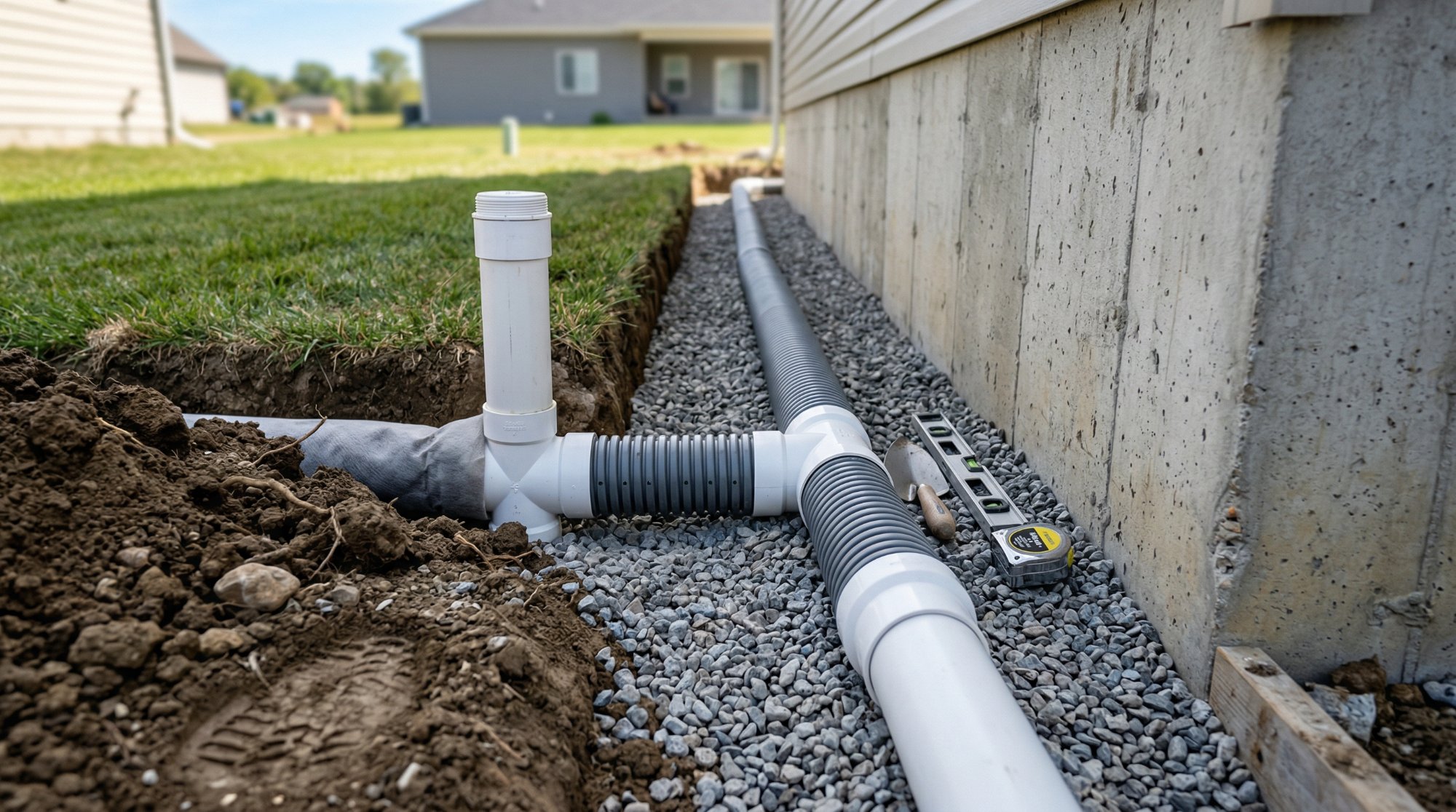
- Water against the foundation. A perimeter French drain (footer drain) installed alongside the foundation captures groundwater before it can pool against your basement walls.
- Slope-related drainage. Water running down a slope toward your house can be intercepted by a French drain installed across the slope.
- Subsurface water issues. When water is moving underground (not just surface runoff), French drains can intercept it.
How French Drains Are Built
The basic recipe:
- Trench dug along the wet area, typically 18–36 inches deep depending on the application
- Filter fabric lining to keep soil out of the gravel
- Layer of clean gravel (washed stone)
- Perforated pipe (4-inch typically) running through the gravel
- More gravel covering the pipe
- Filter fabric folded over the top
- Soil and grass restored on top (or decorative gravel for surface visibility)
- Pipe outlets to daylight, a dry well, or storm drainage
Dry Wells — When You Need One
Dry wells make sense when:
- Downspout disposal. Your downspouts dump water in a spot that needs better dispersal.
- Sump pump discharge. A basement sump pump needs somewhere to send water that's not just a few feet from the foundation.
- End of a French drain run. If a French drain doesn't have a natural outlet (no nearby slope to daylight, no storm drain to tie into), a dry well at the end gives the water somewhere to go.
- Roof runoff in tight lots. Where you can't extend downspouts far enough away from the house above ground, a dry well buried in the yard handles disposal underground.
How Dry Wells Are Built
Two common types:
- Gravel pit. A 4–6 foot deep pit filled with washed stone, lined with filter fabric. Water enters from a pipe and slowly percolates out into surrounding soil.
- Pre-fabricated tank. A perforated plastic or concrete tank buried in the same kind of pit. Holds more water than a pure gravel pit. More common for higher-volume applications.
Critical: Soil Conditions Matter
Both solutions depend on the soil being able to absorb water somewhere:
- Sandy or sandy-loam soil (much of Ocean County, parts of Jackson and Howell): drains well, dry wells work efficiently, French drain outlets to ground are reliable.
- Clay-heavy soil (common in inland Monmouth and Middlesex): drains poorly, dry wells fill up faster than they empty in some cases, French drains need to outlet to daylight or storm drainage rather than back into clay.
This is why "just install a French drain" without thinking about where the water goes is how some installations fail within a year. The water needs a real outlet.
Combining the Two
The most robust drainage installs typically combine both:
- French drain runs along the problem area (foundation perimeter, wet zone, slope intercept)
- French drain outlets to a dry well buried in a part of the yard with good percolation
- Dry well disperses the water into surrounding soil over time
For larger volumes (whole-house roof runoff, sump discharge for a wet basement), the dry well might be supplemented with a connection to existing storm drainage if available.
What This Costs
Ranges for typical residential installs in Central NJ:
- French drain: $2,000–$8,000 depending on length and depth
- Dry well: $1,500–$5,000 depending on size and type
- Combined system: $4,000–$12,000
Cheaper isn't better. A poorly installed French drain that clogs in 3 years (no filter fabric, wrong gravel, undersized pipe) costs more in the long run than a properly installed one that lasts 30+ years.
Common Mistakes We See
- French drains installed without filter fabric — fill with sediment and clog within a few years
- Dry wells installed in clay soil with no plan for what happens when they fill up
- Undersized installations for the actual water volume
- No consideration for where outlet water actually goes (often onto the neighbor's property, which becomes their problem and your liability)
- Pipe pitched wrong — water doesn't flow if there's no slope
Getting It Right
The right drainage solution starts with understanding your specific property — soil type, water source, available outlet options, and the actual volume you're managing. We assess all of that on-site before quoting any work.
Free assessments anywhere in Jackson, Howell, Monroe, Old Bridge, and the rest of our Central NJ service area. Call (908) 670-7297.