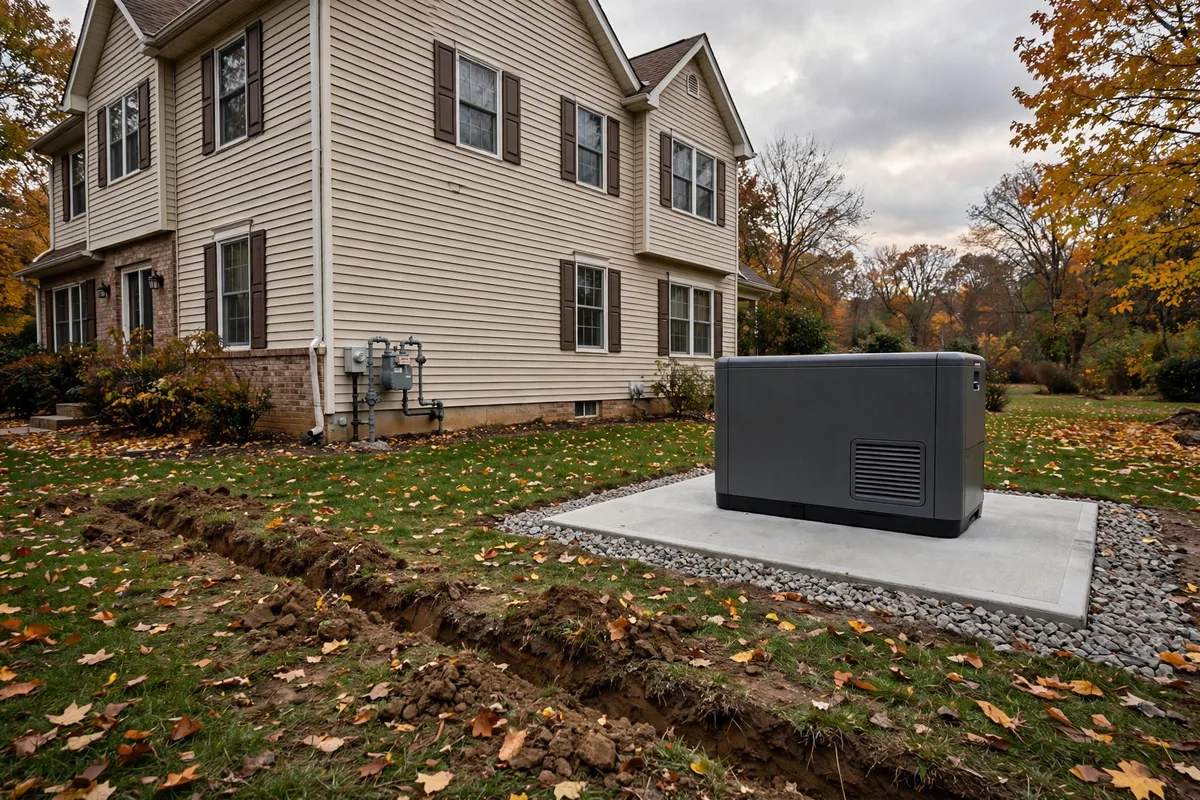
Why the Ground Under a Generator Matters
A standby generator is not a patio chair. It is a few hundred pounds of engine that starts itself every week to exercise, vibrates every time it runs, and sits outdoors through every freeze and every storm. If the base under it settles even slightly, the unit goes out of level. Out of level means uneven vibration, extra wear, and stress on the gas and electrical connections. If the base does not drain, the unit sits in water, which is the last thing you want around equipment designed to run during a downpour.
The generator is built to be reliable. The site has to let it be.
What Does Good Pad Prep Look Like?
Whether the unit sits on a poured concrete pad or the composite pad many models ship with, the work underneath follows the same logic as any slab we pour:
- Strip to stable soil. Topsoil, sod, and roots come out. Organic material decomposes and settles, which is the same reason we pull stumps instead of grinding them under anything that has to stay put.
- Build a compacted stone base. Clean crushed stone, placed and compacted, gives a firm platform that drains. This is the layer that actually keeps the unit level for the next fifteen years.
- Set it level, with a slight lift above grade. The finished pad should sit a little above the surrounding ground so water moves away from it, not toward it.
- Grade around it. The soil around the pad should slope away, and downspout discharge should not be aimed at it. Our regrading post covers the same principle at the scale of the whole house.
The base and drainage rules from our concrete pad post apply here too, just at a smaller footprint.
Where Should the Generator Go?
Placement is mostly set by clearances, and they are tighter than people expect. Generac, the most common brand we see in Central NJ, lists these:
- 5 feet from windows, doors, vents, and window wells, because exhaust contains carbon monoxide.
- 3 feet of clear space at the front and both ends, including shrubs and plantings, for airflow and service access.
- 5 feet of open space overhead, which rules out tucking it under a deck or a low overhang.
- 18 inches from the house wall itself, but only for specific models that were tested for it. Others need more.
Local code always takes precedence, and the model’s installation manual has the final numbers. In practice, those clearances usually narrow the options to one or two spots on the property. The job then is making sure the spot the clearances allow is not also the spot where water collects.
The Trenching Nobody Mentions
A generator needs fuel and it needs to connect to the house. On most installs that means an underground gas line from the meter or propane tank and an electrical conduit run to the transfer switch. Both go in trenches, and trenching is excavation work with all the usual rules: confirmed utility locates before anything gets dug, the right depth for what is going in the trench, and backfill that is compacted so the trench line does not sink into a rut in the lawn by spring.
A trench across an established yard is also a restoration job. Getting topsoil and seed down in the fall, while it can still take, beats looking at a scar across the lawn all winter.
Why Do This Before Outage Season?
Because the demand curve is predictable. The calls come the week after a big outage, the installers book up, and anyone starting from scratch in December is working through frozen ground and a crowded schedule. Site prep done in October means the pad, the base, and the trenches are ready whenever the installer is, and the generator is running before the storms that made you want one in the first place. It fits the same calendar logic as our storm season prep post.
Get the Site Ready
Mannino Excavation handles generator pad prep, stone bases, poured pads, trenching for gas and conduit, and the grading and restoration around them across Monmouth, Middlesex, and Ocean County. We coordinate with your electrician and gas installer so the site is ready when they are. (908) 670-7297, free estimates.
Frequently Asked Questions
Does a standby generator need a concrete pad?
It needs a level, stable, well drained base, and that can be a poured concrete pad or a manufactured composite pad set on compacted gravel. Many units ship with a composite pad. Either way, what is underneath matters most: a compacted stone base that drains and will not settle keeps the unit level and dry for years.
How far does a standby generator have to be from the house?
Generac lists 5 feet from windows, doors, vents, and window wells, 3 feet of clear space at the front and ends, and 5 feet overhead. Some tested models may sit as close as 18 inches from the wall itself. Exact requirements depend on the specific unit and your local code official, so confirm before choosing a spot.
Where is the worst place to put a standby generator?
In a low spot. Anywhere water collects during heavy rain will eventually put standing water around the unit, and that is exactly the weather when it needs to run. Also avoid spots near bedroom windows, under decks or overhangs, and anywhere the required clearances to openings cannot be met.
Who handles the trenching for a generator install?
The gas line and electrical conduit usually run underground between the generator, the gas meter or tank, and the house. The electrician and gas installer make the connections, but the trench itself is excavation work. It should be dug to the right depth, kept clear of other utilities found during locates, and backfilled and compacted properly.
Do I need a permit to install a standby generator in NJ?
Yes. Standby generator installations go through your local construction office, typically involving electrical and fuel gas permits and inspections. The installer usually pulls them. Site prep and trenching are part of the same project, so schedule them to line up with the permit and inspection timeline rather than as an afterthought.