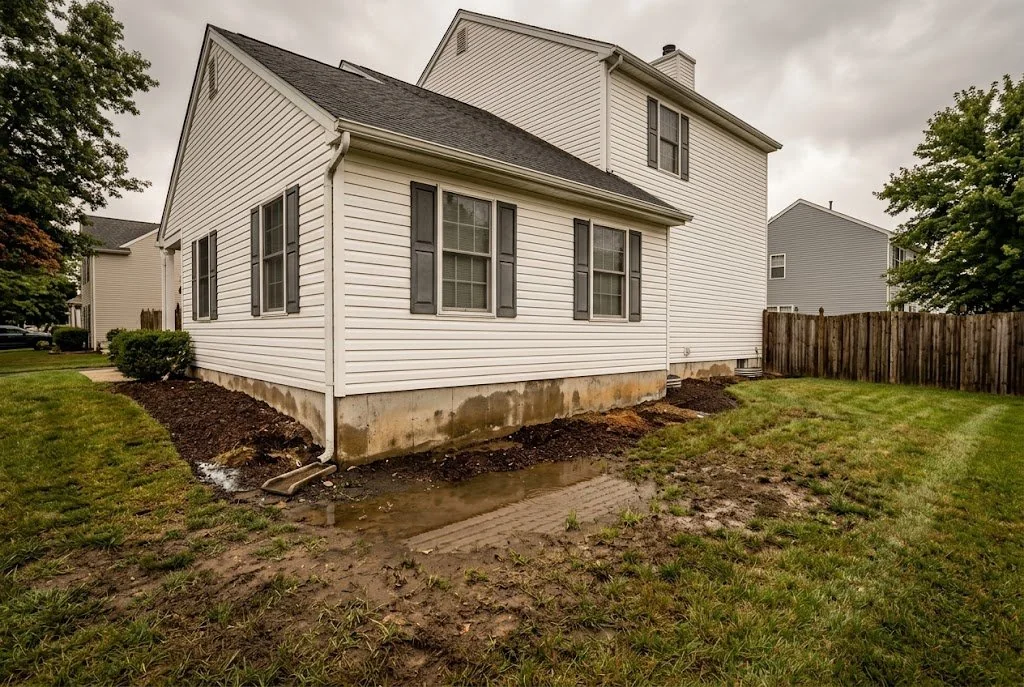
What "Grading" Actually Means
The grade of your property is the slope of the ground around your house. Proper grade slopes away from the foundation — typically a 5% grade for the first 10 feet, meaning the ground drops about 6 inches over that distance. This forces water away from your house instead of letting it pool against the foundation.
Sounds simple. The problem is that grading shifts over time. Soil settles, landscaping matures, additions get built, downspouts get added or moved, and what was correct grade 20 years ago has slowly tilted in the wrong direction.
The Visible Warning Signs
Standing Water Near the Foundation After Rain
The most obvious sign and the most ignored. If you see puddles within a few feet of your foundation 24+ hours after a rainstorm, you have a grade problem. Water shouldn't be sitting there — it should have drained away.
Wet or Damp Basement Walls
Damp spots on basement walls, especially after heavy rain, almost always trace back to bad grading or failed drainage. The water isn't coming through solid concrete — it's finding its way down because the grade is letting it pool against the foundation.
Cracks in Foundation or Basement Walls
Hydrostatic pressure from saturated soil pushes against foundation walls. Over time, this causes:
- Hairline cracks (early warning)
- Stair-step cracks in block foundations (more serious)
- Horizontal cracks (very serious — wall is bowing inward)
Cracks don't always mean grade problems, but bad grade dramatically accelerates them.
Soil Erosion or Channels in the Yard
If you can see actual channels carved by water flow during rain, especially near the house, water is moving where it shouldn't. That same flow is doing damage you can't see.
Mulch or Landscaping Washing Out Repeatedly
If you re-mulch flower beds every year because rain washes it away, you don't have a mulch problem — you have a grade or drainage problem.
Settling, Sinking, or Heaving
Concrete walkways, patios, or driveway sections that have shifted, sunk, or heaved are often related to water moving through poorly graded soil underneath. Freeze-thaw cycles in NJ winters make this worse.
Mosquito Breeding in Persistent Wet Areas
Standing water that lasts more than a few days breeds mosquitoes. If you have parts of the yard that are always wet, that's a quality-of-life issue on top of the structural risk.
Fungus, Mold, or Moss on the Lower Foundation
Visible mold or moss on the lower portion of foundation walls outside means that area stays wet much longer than it should. The cause is usually upstream — bad grading directing water there.
What Causes Grade Problems
- Original construction was done poorly. Builders sometimes leave properties with the bare minimum slope, or even negative slope back toward the house in spots.
- Soil settling. Backfill around new foundations settles for years. What was 5% slope at year 1 might be 1% slope at year 10.
- Landscaping changes. Adding mulch beds, raising garden borders, or changing the lawn elevation near the house can reverse the original grade.
- New hardscape. Patios, walkways, and driveways sometimes get installed in ways that direct water back toward the house instead of away.
- Downspout extensions failing. If downspouts dump water within a few feet of the foundation instead of being extended out, you've effectively eliminated the grade benefit at those spots.
What a Regrade Actually Involves
For a typical residential regrade:
- We assess the existing grade with a transit or laser level to identify where the problems are
- Discuss with you whether to fix the worst spots or do a comprehensive regrade
- Bring in fill material if needed (clean topsoil, often)
- Reshape the grade to slope away from the foundation correctly
- Compact appropriately so it stays in place
- Often combine with downspout extensions or French drains for complete water management
- Re-seed or sod the disturbed area
When Regrading Isn't Enough
Sometimes the grade is okay but the underlying drainage is the real issue. In that case, regrading alone is a band-aid — you need to combine it with proper drainage. We wrote about French drains vs dry wells here → to help you understand what your specific situation might need.
The Cost of Waiting
A regrade today: $2,500–$10,000 for most properties.
A regrade plus foundation crack repair after years of bad grading: $10,000–$25,000.
A regrade plus full waterproofing and basement remediation: $20,000–$50,000.
The earliest fix is always the cheapest fix. If you're seeing any of the warning signs above, schedule a free assessment.
Mannino's Approach
We've graded everything from quarter-acre lots in East Brunswick to multi-acre estates in Marlboro and Millstone. Frank walks the property, identifies the actual problem (often it's not what the homeowner thought), and gives you an honest scope. Free estimates, no high-pressure sales. Call (908) 670-7297.