The Pool Company Does the Pool. Period.
This is the first thing to understand if you're new to the process. Pool companies are specialists. They install pools — gunite, vinyl liner, fiberglass — and they're the right people for that part of the project. They are not, in most cases, the right people to:
- Take down trees in the way of the pool location
- Move boulders or excavate around rock
- Tie pool drainage into a property's overall drainage system
- Dispose of large volumes of excavated soil
- Build retaining walls if the yard slopes
- Run utility access (gas line, electrical) outside the pool equipment pad itself
- Restore the rest of the yard once the pool is done
Some pool companies will subcontract this work. Others won't touch it. Either way, it's your problem as the homeowner to coordinate, and it's smarter to handle it on your terms with people you've vetted than to inherit whatever subcontractor the pool company calls.
The Site Survey Comes First
Before any excavation talk, you need to know:
- Property lines and setback requirements (your township's zoning office)
- Where utilities run (gas, water, sewer, electric — Call 811 to mark them, or hire a private locator for accuracy)
- Where the septic system and leach field are if you have one
- What's underground that you don't know about (old fuel tanks, abandoned cisterns, demolished outbuilding foundations)
An ill-placed pool that's three feet over the setback line is an expensive mistake. A pool dig that hits an old oil tank is a stop-everything environmental remediation event. The site survey prevents both.
Tree Removal and Land Clearing
Most pool installations require taking down 1-5 trees and clearing brush from the work area. The pool company won't do this. A landscaping company can do it but typically without considering the access path the pool excavator will need to drive through.
Site work order matters here:
- Tree removal first (cleared workspace)
- Stump grinding or stump removal (excavator can drive through)
- Path clearing for equipment access (specifically wide enough for the dump trucks and excavators that will run for several days)
- Then pool excavation
If steps 1-3 are done badly or skipped, the pool company shows up and charges you for the delays while they figure out how to get equipment to the dig location.
Excavation and Spoil Removal
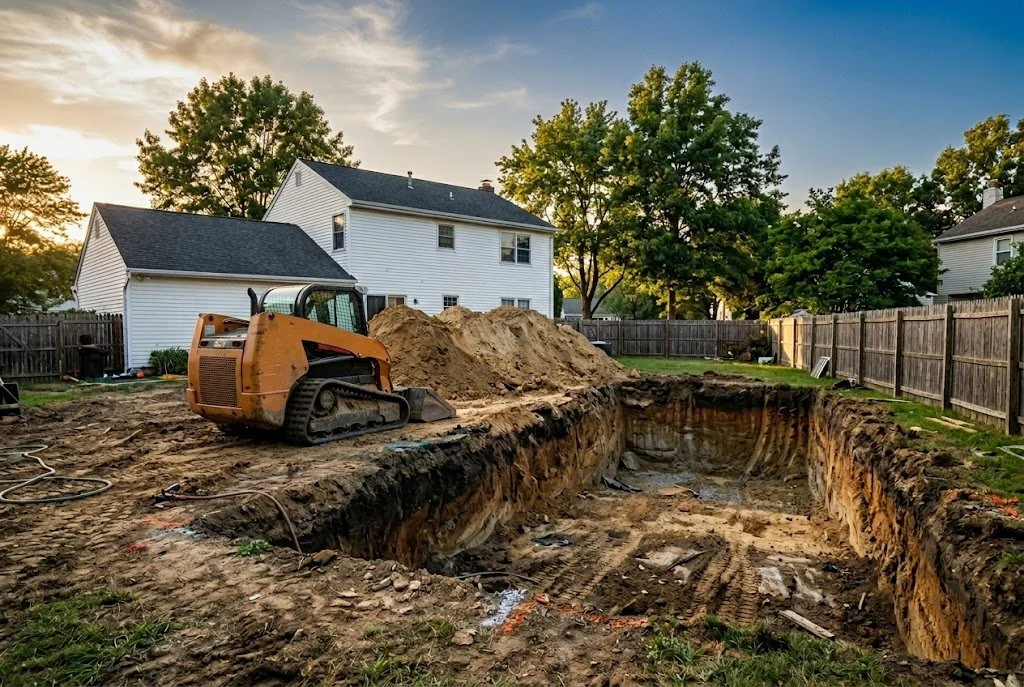
An average backyard pool involves excavating roughly 40-80 cubic yards of soil. That's 4-8 dump truck loads of dirt that has to go somewhere.
Your options:
- Use it as fill on the property. Sometimes possible if your yard has low spots that need filling. Cheapest option but rarely the right look aesthetically.
- Haul it off-site to disposal. The standard approach. Costs depend on how far the disposal site is and how clean the soil is.
- Save some for backfill, haul the rest. Common compromise — some dirt goes back around the pool shell, the rest leaves.
The pool company is digging the pool hole specifically. Anything beyond that — grading the surrounding yard for drainage, hauling dirt to a different part of the property, getting topsoil in for landscaping after — is excavation work.
Drainage Around the Pool
This is the biggest mistake we see homeowners make. They build a beautiful pool with a deck around it, and then the first heavy rain demonstrates that the surrounding grade is sending water toward the pool deck instead of away from it. Now they have:
- Standing water on the deck after every storm
- Mulch and dirt washing into the pool
- Long-term erosion under the deck supports
- Possible damage to the pool shell or deck if water gets behind it
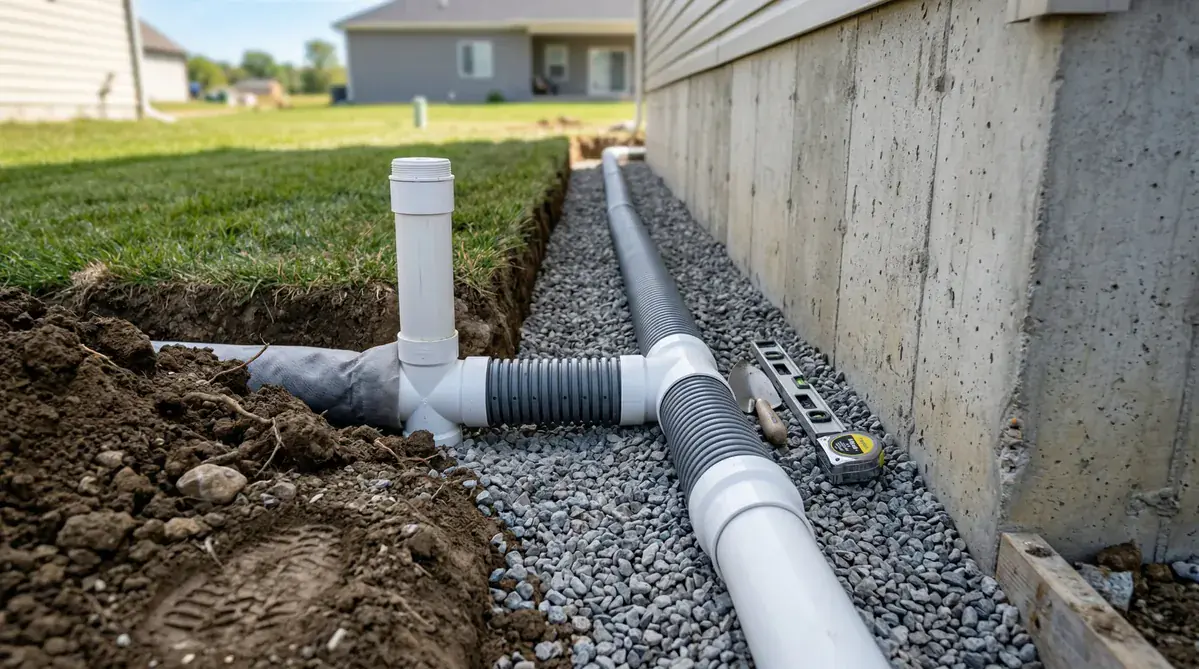
The fix is to plan drainage during site prep — before the pool deck goes in. That typically means:
- Re-grading the area immediately around where the deck will be so it slopes away from the pool
- Installing a French drain or trench drain at the perimeter of the deck if the yard slopes toward the pool
- Tying that drainage into a dry well or daylight outlet
We've written about French drains vs dry wells if you're trying to understand which one fits your situation.
Retaining Walls for Sloped Yards
If your yard isn't flat where you want the pool, you need to talk about retaining walls before the pool goes in. The pool itself is going to be perfectly level — the surrounding yard needs to be brought up or down to meet that level.
Common scenarios:
- Pool above the natural grade: requires a retaining wall on the downhill side, usually with backfill
- Pool below the natural grade: requires a retaining wall on the uphill side to prevent erosion onto the deck
- Tiered installations: the pool sits at one level with a retaining wall stepping down to a lower yard level
Retaining walls are real engineering, especially anything over 4 feet, which often requires permits and engineering review in NJ. Plan for this in the timeline.
Utility Routing
The pool needs:
- Electrical from the house to the pool equipment pad (typically run by a licensed electrician)
- Possibly a gas line if you have a heater (run by a licensed plumber)
- Water access for filling and topping off (usually just a hose bib extension)
The trenching for these utility runs is excavation work. Sometimes the pool company subs it out. Sometimes they leave it to you. Coordinate before the pool company shows up — running these lines after the deck is poured is dramatically more expensive than running them during site prep.
Post-Install Restoration
After the pool is in and the deck is poured, your yard looks like a war zone. Equipment has compacted the lawn, dirt is everywhere, and the area outside the immediate pool zone needs serious restoration. Typically:
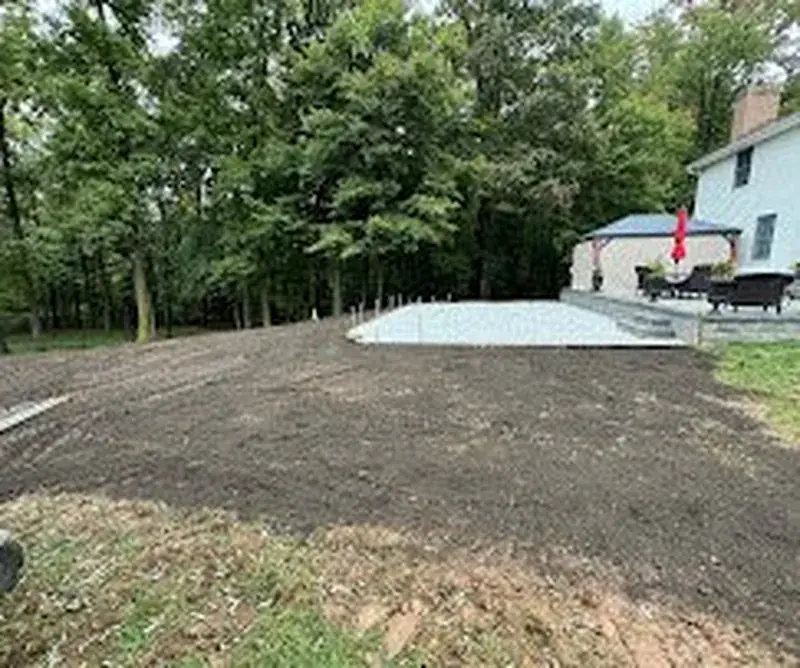
- Re-grading the surrounding yard to its final shape
- Topsoil and seeding (or sod, depending on budget and timeline)
- Repairing any damage to driveways or hardscape from equipment access
- Installing landscape elements that screen the equipment pad from view
This is excavation work too. The pool company is gone after the deck cures. Whoever does this last phase determines how the finished project actually looks.
Real Timeline Expectations
An end-to-end residential pool project — from "we want a pool" to "the pool is open and the yard is restored" — runs roughly 4-6 months in NJ. That breaks down as:
- Weeks 1-3: Design, contract with pool company, site survey
- Weeks 3-8: Permits, township approvals
- Week 8-9: Site prep — tree removal, clearing, access prep, initial grading (excavation contractor)
- Weeks 9-13: Pool excavation and shell installation (pool company)
- Weeks 13-16: Pool plumbing, equipment, deck (pool company)
- Weeks 16-20: Drainage, final grading, landscaping restoration (excavation/landscaping)
If you want to swim by Memorial Day, that's a project that started in November. By Labor Day? Started in March. The site work portions on either end of the pool company's part are non-trivial chunks of the schedule.
How We Work With Pool Projects
We do the site prep before, the drainage during, and the restoration after. We coordinate directly with whatever pool company you've chosen — they handle the pool, we handle the property work around it. Doing it this way means you have one excavation contractor for the whole project arc and one pool company for the actual pool, and the two work cleanly with each other.
If you're early in the process, we're happy to do a free site visit to walk through what your specific yard needs before, during, and after the pool installation. Easier to plan it now than to fix it after the deck is poured.
Call (908) 670-7297 for a free estimate.