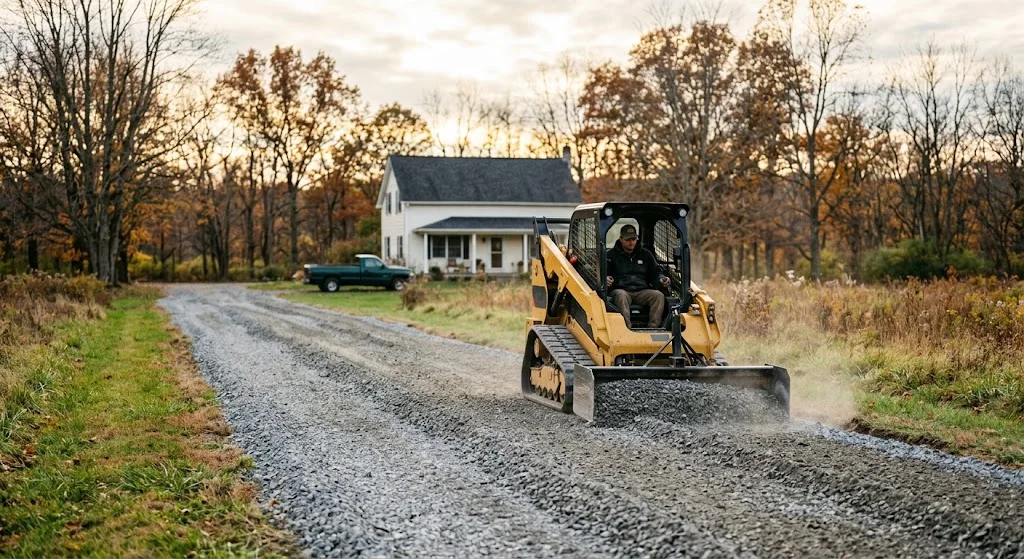
Why Gravel Driveways Fail
Almost every failing gravel driveway in Central NJ has the same two problems, and they feed each other.
The crown is gone. A driveway is supposed to be slightly higher in the middle so water runs off both sides. Years of traffic, plowing, and dragging flatten that crown out, and some driveways end up dished, which is worse than flat. Once water stops leaving the surface, it sits, soaks in, and softens the base.
The base has thinned or gone muddy. Stone works by locking together over a firm foundation. When fines wash away or subgrade mud pumps up into the stone, the layer stops behaving like a structure and starts behaving like loose material sitting on soup. That is when ruts appear after every rain.
Everything people complain about, the potholes, the washboarding across the surface, the soft spots that swallow a truck tire, comes out of those two conditions.
What Does an Actual Repair Involve?
There is a difference between grooming a driveway and fixing one. Grooming is dragging a box blade over the surface to redistribute the stone that is already there. It looks better for about three weeks. A real repair is a sequence:
- Assess the base. Is there still stone under there, or is it mud with gravel sprinkled on top? That answer decides the whole scope.
- Address the water first. Clear roadside ditches and shoulders so water has somewhere to go. If a culvert runs under the driveway, confirm it still flows. A crushed or silted culvert turns the driveway into a dam, and no amount of stone fixes that.
- Reestablish the crown. Cut and shape the surface so the center sits higher than the edges, with enough pitch to actually shed water.
- Add the right stone in the right order. Base stone where the structure needs rebuilding, dense grade surface material on top.
- Compact it. This is the step that gets skipped. Uncompacted stone is just a pile that cars will rearrange for you over the next month.
What About the Culvert?
Any driveway crossing a ditch has a pipe under it, and most homeowners have never looked at theirs. A culvert that is crushed, silted in, or undermined causes problems that look like driveway problems: water backing up across the surface, a soft shoulder, a section that washes out every heavy rain. Fall is the time to find out, because once the ditch is frozen and snow covered you are not fixing it until spring. This is the same water management logic from our storm season prep post, just applied to the one place every vehicle crosses.
Why October Specifically?
Three reasons line up this month. The ground is dry enough that new stone compacts properly instead of pumping into mud. The surface gets a few weeks of traffic to set up before freeze thaw starts prying it apart. And most importantly, it is done before plow season, which matters more than people expect.
A plow on a good driveway is a non event. A plow on a bad one is a force multiplier: the blade catches soft edges and drags stone into the lawn, rides down into potholes and deepens them, and finds every washed out shoulder. If you are getting on a plow list this fall, as we covered in why properties sign up in September, having the driveway in shape first protects the investment on both ends.
What Does It Cost?
Central NJ residential gravel driveway work generally runs $1,500 to $6,000. Reshaping and recrowning a driveway with a decent remaining base is at the low end. Long driveways, significant stone quantity, rebuilding failed sections, shoulder repair, or culvert replacement push toward the top. The two biggest variables are length and whether drainage has to be solved along with the surface.
For comparison, letting it go means a bigger scope next year: more stone to replace what washed away, more base rebuilding where mud has taken over, and sometimes regrading the surrounding ground where runoff carved new paths. Driveways are one of the clearest cases where maintenance is genuinely cheaper than repair.
Get It Done Before the First Storm
Mannino Excavation regrades, recrowns, and rebuilds gravel driveways across Monmouth, Middlesex, and Ocean County, including shoulder work, culverts, and the drainage that keeps a driveway from failing again. Owner on the equipment, stone delivered and compacted properly. (908) 670-7297, free estimates.
Frequently Asked Questions
Why does my gravel driveway keep getting potholes?
Potholes form where water sits. If the driveway has lost its crown, water stops running off the sides and ponds on the surface instead. Traffic pushes that saturated stone out of the way, the low spot gets lower, and it holds even more water next time. Filling the hole without fixing the crown means the same pothole returns within a season.
What kind of stone should go on a gravel driveway in NJ?
A working driveway needs two layers doing different jobs. A coarse base stone such as a 2 to 3 inch crushed material carries the load and locks together, and a finer surface layer such as quarry process or dense grade fills the voids and compacts into a firm driving surface. Pouring loose decorative round stone on top of mud is the most common mistake.
How much does gravel driveway repair cost in Central NJ?
Most residential jobs land between $1,500 and $6,000. Regrading and reshaping an existing driveway that still has decent base sits at the low end. Adding significant stone, rebuilding failed sections, fixing shoulders, or replacing a collapsed culvert pushes toward the high end. Length and access drive the number more than anything else.
When is the best time to regrade a gravel driveway?
Early to mid fall is ideal in New Jersey. The ground is dry enough to compact properly, the stone sets up before freeze thaw starts working on it, and the driveway is in shape before plow season. Spring is the second choice, though wet ground makes compaction harder and you have already spent a winter on a bad surface.
Will a snow plow damage my gravel driveway?
A plow run over a properly crowned and compacted driveway does very little harm. A plow run over a soft, rutted, potholed driveway pulls stone into the lawn, catches on edges, and deepens every existing problem. Fixing the surface before the first storm protects both the driveway and the plow.