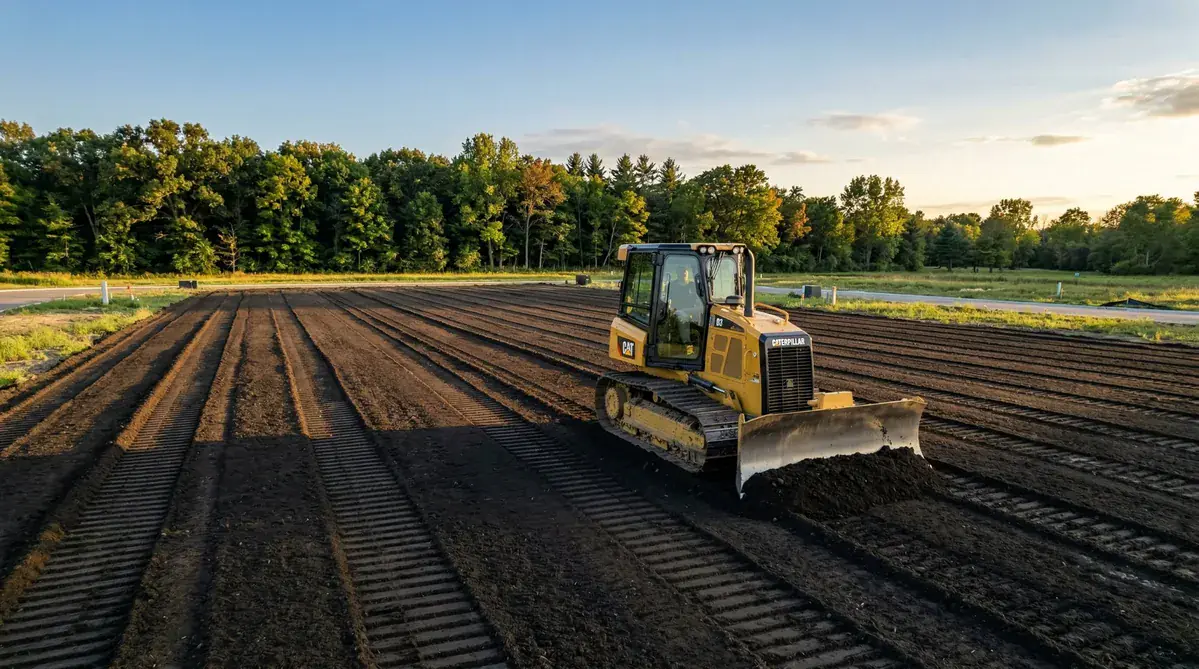
What Actually Goes Wrong Over a NJ Winter
An unfinished site is a system that was interrupted mid sequence. Winter tests it in four ways at once:
- Erosion. Bare soil has no root structure holding it. Every rain and every melt moves some of it, and it always moves downhill, which is usually toward a neighbor, a road, or a drainage structure.
- Freeze thaw. Water gets into exposed soil, freezes, expands, and breaks the surface apart. Repeat that thirty times over a winter and trench walls slump, graded surfaces lose their shape, and compacted areas loosen.
- Water finding new paths. A half finished grade has no finished drainage. Water pools where it was never meant to sit, saturates soil you will need to build on, and sometimes routes straight at the structure you were digging for.
- Sediment leaving the property. This is the one with real consequences. Sediment in a street, a storm drain, or a waterway is a compliance problem, and in NJ it can become a township problem fast.
How Do You Actually Close a Site Down?
A proper winter shutdown is a short list, done before the weather forces it:
- Stabilize the bare soil. Seed and straw where there is still time for germination, erosion control blankets on slopes, and straw or mulch cover everywhere else. The goal is to get something between the rain and the dirt.
- Protect the perimeter. Silt fence at the down slope edges, in the ground properly rather than staked loose, and inlet protection on any catch basin that could take runoff from the site.
- Give water a plan. Temporary swales and diversions so the runoff has somewhere to go that is not through the excavation or across the neighbor's lawn. This is the same principle as the grading work in our regrading post, just built to last one season instead of twenty.
- Deal with open excavations. Backfill what can be backfilled. What has to stay open should be sloped or benched, fenced, and kept clear of standing water. An open hole that fills and freezes is both a safety issue and a soil problem.
- Secure stockpiles. Topsoil and fill piles need cover and a silt fence ring, otherwise a third of the pile ends up somewhere else by March and you buy material twice.
- Keep an access route. Leave a stabilized path in. A site you cannot get equipment onto in March is a site that does not start in March.
What Does This Cost Versus Skipping It?
Winterizing is a small line item: material, a day or two of work, and a little planning. The alternative shows up as spring regrading to rebuild what eroded, re excavating slumped trenches, replacing washed out stockpile material, cleaning silt out of drainage structures, and occasionally a township conversation about sediment that left the property. For scale, a yard regrade alone typically runs $2,500 to $10,000 in Central NJ, and that is money spent getting back to where you already were in November.
When Should This Happen?
Before the shutdown is forced on you. The window for seed to establish closes earlier than most people think, and silt fence is far easier to install into ground that is not frozen. If you already know a project is going to sit, treat the winterization as its own scheduled task in October or early November rather than something to handle on the first cold week. That is the same reason we push planning into fall in our spring timeline post: what happens over winter determines how fast spring goes.
If Your Project Is Stalling Out
Whether we started the work or not, Mannino Excavation can assess an open site and close it down properly for the season, then pick it up when the ground opens. Site stabilization, erosion control, temporary drainage, and backfill across Monmouth, Middlesex, and Ocean County. (908) 670-7297, free estimates.