Before the Dig: What Should Already Be Done
By the time the excavator shows up, several things should be in place:
- Permits issued. Excavation permits, building permits, and if applicable, soil disturbance permits
- Site survey complete. Property lines marked, building corners staked, setbacks confirmed
- Utilities marked. Call 811 (in NJ this is the One Call System) — gas, electric, water, sewer, telecom all marked. This is non-negotiable. Hitting an unmarked line is a worst-case-scenario disaster.
- Erosion control in place. Silt fences and any other required sediment controls installed before disturbance begins
- Tree clearing complete. If land clearing is part of the scope, that happens before the foundation dig
- Access route established. Where will the excavator come in? Where will spoil pile go? Where will trucks back in?
Day 1: Site Prep and Layout
The excavation crew arrives, confirms the layout against the survey stakes, and sets up. This includes:
- Final review of the foundation plan against the staked layout
- Locating spoil disposal — typically a pile on-site to be used as backfill, or staging for haul-off
- Setting any temporary benchmarks needed to maintain elevation accuracy
- Establishing the dig perimeter, often with chalk lines or paint
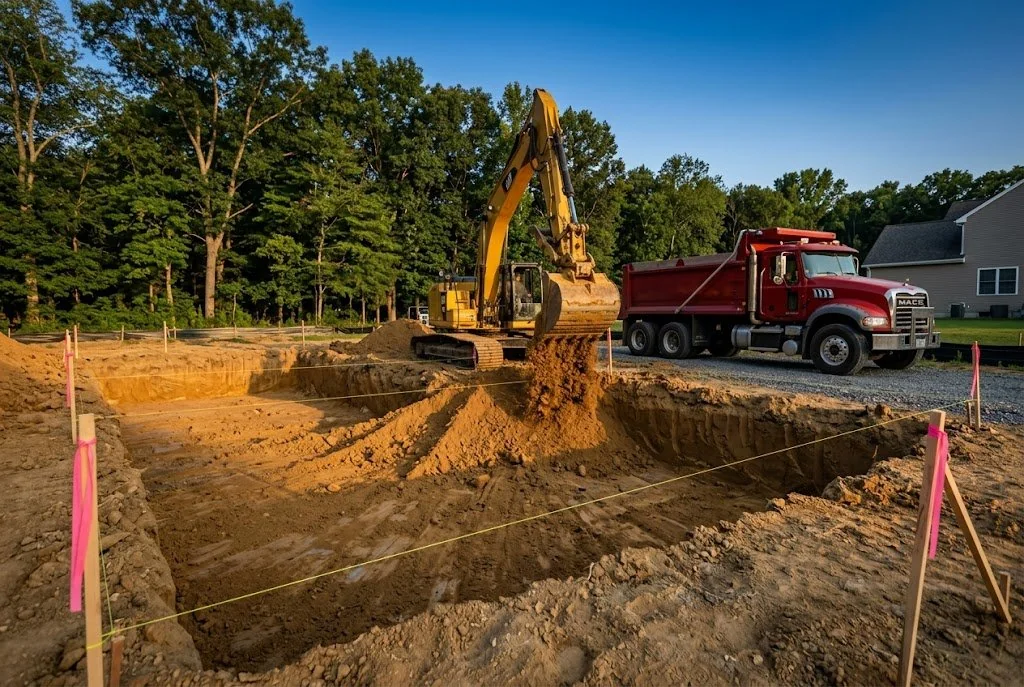
Day 1–3: The Dig Itself
For a typical residential basement foundation (around 30x40 footprint, 8 feet deep):
- The excavator removes topsoil first (saved for later use as fill or finish landscaping)
- Working in lifts of 2–3 feet, the operator excavates down to design depth
- Spoil is piled at the staging location
- Walls are cut to grade — vertical walls if soil holds, sloped (battered) if soil is loose
- Bottom is leveled to design elevation, ready for footings
What Can Go Wrong Here
- Hitting rock. Most NJ residential digs don't hit significant rock, but it happens. Rock means jackhammer work, blasting in extreme cases, and significant cost increases.
- Hitting groundwater. Common in areas with high water tables. Means dewatering with pumps and possibly redesigning footing depth.
- Soil collapse. Loose sandy soil (common in parts of Jackson, Lakewood, Toms River) can slough. Experienced operators read the soil and shore appropriately.
- Hitting unmarked utilities. If 811 was called and an unmarked line gets hit, it's the utility company's liability. Without 811, it's yours.
Day 3–5: Footings and Wall Forms
Once the dig is complete, the excavation crew typically hands off (or coordinates closely with) the foundation/concrete crew:
- Footing trenches dug into the bottom of the excavation (additional 12-16 inches deep)
- Footings poured first, allowed to cure
- Foundation walls formed (or block walls laid, depending on construction type)
- Walls poured, cured
- Forms stripped
At Mannino, we can handle the concrete work too, which keeps the project under one accountable contractor instead of finger-pointing between separate excavator and concrete crews.
Week 2: Waterproofing and Drainage
- Exterior waterproofing membrane applied to foundation walls
- Footer drains (perforated pipe) installed around the perimeter
- Drains connected to outlet (daylight, dry well, or storm drain)
- Initial inspection from the building inspector
Week 2–3: Backfill and Compaction
This is where a lot of foundations get damaged by inexperienced crews. Backfill needs to be done carefully:
- Walls must be braced first — never backfill against a wall that hasn't fully cured and isn't supported
- Backfill in lifts (12-18 inches at a time), compacting between lifts
- Use proper backfill material — clean fill, not random debris
- Avoid heavy equipment too close to walls during backfill
- Final grade established sloping away from the foundation
Why Bad Backfill Is a Disaster
Improper backfill can crack new foundation walls before they ever bear a load. We see this on jobs that weren't ours — homeowners who got a low bid, the crew rushed the backfill, and now there are visible cracks before framing even started. Fixing it after means partial demo and re-pour. Catastrophic cost.
Week 3+: Site Restoration
- Final grade established, sloping away from foundation at proper pitch
- Erosion control maintained until vegetation re-established
- Topsoil restored where saved
- Driveway and walkway prep if part of scope
- Site cleaned of construction debris
How Long the Whole Process Takes
For a typical residential foundation (excavation through backfill, weather permitting):
- Pure excavation: 2–4 days
- Footings and walls (concrete cure included): 1–2 weeks
- Waterproofing and drains: 1–2 days
- Backfill and grade: 2–3 days
Total: 3–4 weeks for the full foundation phase, weather and inspection schedules permitting.
What to Ask Your Excavation Contractor
- Are you licensed and insured? Can I see proof?
- Will the owner be on-site, or am I getting a subcontracted crew?
- What equipment will you use? Is it owned or rented?
- How do you handle unexpected soil conditions or rock?
- What's the schedule, and what happens if weather pushes things?
- Will I get an itemized estimate?
- What's your approach to backfill?
- Can I see references from recent similar projects?
The Mannino Difference on New Construction
Frank Mannino runs every job. The CAT equipment is owned, not rented, so we don't have to wait for rental availability or stop work when a rental's hours are up. We've done foundations from compact East Brunswick lots to multi-acre Millstone custom builds. The owner-operated approach means consistent quality, accountable communication, and no surprise change orders.
Free on-site consultation for any new build project in Central NJ. Call (908) 670-7297.