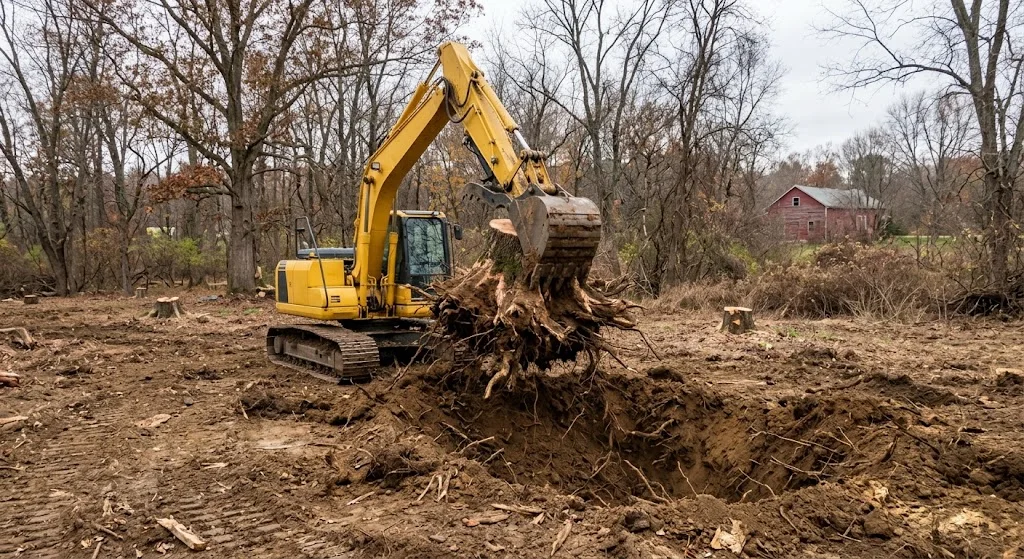
What Each One Actually Does
Grinding uses a rotating cutting wheel to chew the stump down to roughly 6 to 12 inches below grade. What is left is a hole full of wood chips and soil, and an intact root system still in the ground. You rake it out, add topsoil, and seed. The visible stump is gone the same day.
Removal uses an excavator to work the stump loose and pull the whole root ball out. What is left is a real hole, sized to the root mass, that gets backfilled with clean material and compacted. The stump and roots leave the property. It takes more equipment, more time, and more disposal.
The short version: grinding makes the stump invisible, removal makes the ground buildable.
Which One Do You Need?
Ignore the stump for a second and ask what is going in that spot. The answer decides it every time.
Grinding is enough for: lawn, garden beds, mulch, a fire pit area, or anywhere you just want the eyesore gone and the mower to pass. If nothing is being built and nothing rigid is going over it, grinding is the right call and the cheaper one.
Full removal is required for: foundations and additions, concrete slabs and patios, paver hardscape, driveways, septic fields and leach lines, retaining walls, pool excavation, and any finish grading that has to hold a spec. Anywhere the ground needs to carry a load or stay exactly where you put it, the root ball has to come out.
Why Does a Leftover Root Ball Matter?
Because wood in the ground does not stay there. Over the following years it decays, loses volume, and the soil above it drops into the space it used to occupy. Under grass that is a soft spot you top dress once. Under a patio it is a sunken section. Under a slab it is a crack. Under a foundation it is a problem that costs more than the entire original clearing job.
The timing is what makes it dangerous. Decay is slow, so the settling shows up a year or three after the project is done, long after anybody connects it back to the stump nobody removed. It is the same principle behind compacting backfill in lifts, which we covered in our pool demolition post: anything that will change volume later has to be dealt with now.
What Does It Cost?
Grinding a single residential stump is usually a few hundred dollars and scales with diameter. Full excavation removal costs more, because it brings in an excavator, hauls the stump and root ball off site, and backfills the void with compacted material. On a lot with a number of stumps, removal normally gets priced inside a broader clearing scope rather than stump by stump, which is also where it gets more efficient. Our land clearing post covers how that larger scope is priced in NJ.
One thing worth flagging: an estimate that says "stump removal" and means grinding is a common source of disputes. If something is being built on that ground, get it in writing that the root ball is coming out.
Why Fall and Winter Are the Right Season
Clearing work gets easier as the year gets colder. Vegetation goes dormant, undergrowth dies back so you can actually see the lot and the stumps in it, and firm or frozen ground carries equipment without rutting the property. That is why clearing a lot over winter for a spring build is the smoothest version of that sequence, and it keeps the project off the spring scheduling crunch we laid out in the spring timeline post.
Worth checking before anything comes down: many NJ towns have tree ordinances requiring permits or replacement plantings for larger trees, and that applies to the removal, not just the stump.
Not Sure Which You Need?
Tell us what is going in that spot and the answer is usually immediate. Mannino Excavation handles stump removal, land clearing, and the grading that follows across Monmouth, Middlesex, and Ocean County. (908) 670-7297, free site assessments.
Frequently Asked Questions
What is the difference between stump grinding and stump removal?
Grinding uses a cutting wheel to shave the stump down to roughly 6 to 12 inches below ground level, leaving the root ball and lateral roots in place to decay naturally. Removal uses an excavator to pull the entire stump and root mass out of the ground, leaving a hole that gets backfilled and compacted. Grinding treats the surface, removal clears the volume.
Is stump grinding enough before building something?
No. Anything structural needs full removal. A ground stump leaves a root ball that will decay over the following years, and as it breaks down the soil above it settles. Under a lawn that is a minor dip. Under a slab, patio, driveway, or foundation it is a crack or a sunken section, and the failure shows up long after the project is finished.
How much does stump grinding or removal cost in NJ?
Grinding a single residential stump typically runs a few hundred dollars and scales with diameter. Full excavation removal costs more because it involves an excavator, hauling the stump and root ball off site, and backfilling with compacted material. For a lot with many stumps, removal is usually priced as part of a broader land clearing scope rather than per stump.
What happens to the roots left behind after grinding?
They decay in place over several years. As they break down, the soil above them loses volume and settles, which is why ground stump areas often develop a depression a year or two later. The decaying wood also holds moisture and can attract insects, which matters more when the stump was close to a structure.
When is the best time for stump and clearing work in New Jersey?
Fall and winter. Vegetation is dormant, undergrowth has died back so the lot is actually visible, and firm or frozen ground carries equipment without tearing up the property. Clearing a lot over winter for a spring build is the smoothest version of that sequence and avoids spring scheduling pressure.