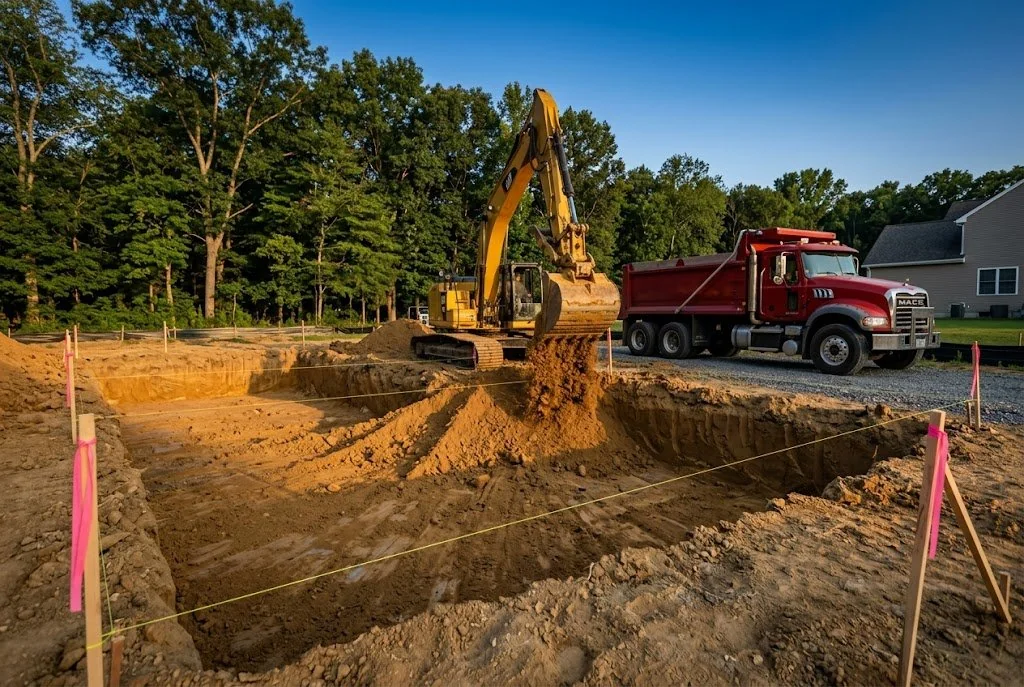
What Is the Frost Line?
The frost line is how deep the ground freezes in a given climate. It matters because of what water does when it freezes: it expands. When moisture in the soil under a footing turns to ice, it takes up more room than it did as water, and the only direction to go is up. That is frost heave, and it does not happen all at once. It happens a fraction of an inch per freeze, over and over, winter after winter.
Put a footing below the frost line and the soil beneath it never freezes, so it never lifts. That is the whole idea, and it is why the depth requirement exists rather than being a matter of preference.
How Deep Is the Frost Line in New Jersey?
The working number across most of New Jersey is 36 inches. Some southern and shore jurisdictions, including sections of the Pinelands and the Cape May area, allow 30 inches. Across Monmouth, Middlesex, and most of Ocean County, plan on 36 inches unless your local construction office tells you otherwise, and confirm before you dig rather than after.
There is a second number worth knowing. Independent of frost, the residential code requires any footing to sit at least 12 inches below undisturbed ground. Even in a climate with no frost at all, a footing has to get down past topsoil and fill to soil that can actually carry load. In NJ the frost number is deeper, so it governs, but the logic behind both is the same: get to ground that does not move.
What Happens If a Footing Is Too Shallow?
Nothing, for a while. That is what makes it dangerous. A deck or addition on shallow footings looks perfect the first year. Then the seasons start working on it:
- Posts and piers lift unevenly, because frost does not act on every footing equally.
- Structures go out of level. Doors stop closing right, railings loosen, decks develop a slope that was not there.
- Concrete cracks under repeated lift and settle cycles.
- It fails inspection, and the fix is not cosmetic. Correcting shallow footings usually means taking apart what is on top of them.
The cost of digging deeper the first time is measured in yards of excavation and concrete. The cost of not doing it is measured in demolition and rebuild.
How Does Frost Depth Change the Excavation?
This is the part that shows up on your estimate. Going from a shallow trench to a 36 inch trench multiplies the volume of soil that comes out and the concrete that goes back in. On a footing running the perimeter of a structure, that difference is significant, and it gets bigger when conditions are not friendly:
- Rock. If shale or diabase shows up before you reach depth, the dig changes character completely. We covered what that looks like and what it costs in what happens when you hit rock.
- Soil type. Clay holds trench walls but drains poorly. Sand digs fast but can need shoring at depth. Our NJ soil types post breaks down what is under different parts of Central NJ.
- Water. A high water table at 36 inches turns a straightforward trench into a pumping job.
None of this is a reason to go shallower. It is a reason to know the site before you price the job, which is why a real site visit beats a phone quote every time.
Is There Any Way Around the Depth?
There is one legitimate alternative: a frost protected shallow foundation, allowed under the residential code and built with rigid insulation that keeps ground heat under the footing so the soil there never freezes. It is a real engineered method with its own design requirements, used more often on slab on grade construction than on typical residential footings. It is not a shortcut, and it is not something to improvise. If a contractor is going shallow without an engineered frost protected design, they are not using an alternative, they are just going shallow.
Practical Takeaways
Ask your local construction office for the frost depth they enforce and get it in writing. Make sure the depth is stated in your contract, not assumed. And if you are planning a foundation, addition, deck, or post job this fall, remember that depth work gets harder once frost is actually in the ground, which is part of the calendar math in our fall excavation season post. Mannino Excavation digs footings and foundations to spec across Monmouth, Middlesex, and Ocean County. (908) 670-7297, free estimates.