The Short Answer: Yes, You Almost Certainly Need a Permit
In most NJ townships, demolition permits are required for:
- Any habitable structure (house, garage with utilities, finished structure)
- Most accessory structures over a certain square footage threshold (varies by township, often 100–200 sq ft)
- Inground swimming pools
- Detached garages and barns
- Foundations being removed
- Structures with utility connections (gas, electric, water, sewer)
Smaller structures — sheds under the threshold, free-standing playhouses, decks in some cases — may not require permits, but check your specific township's rules. The wrong assumption can result in fines and forced restoration.
Why Permits Matter (Beyond Following the Law)
- Insurance. If something goes wrong during unpermitted demolition (injury, neighbor property damage, environmental issue), your insurance company can deny the claim.
- Future sale. Title searches reveal unpermitted work. Demolitions without proper closeout can complicate future home sales.
- Tax records. Tax assessments need to be updated to reflect removed structures, which requires permit records.
- Utility safety. Permit process triggers utility disconnect coordination — you cannot safely demolish a structure with live gas, electric, or water connections.
The Permit Process — Step by Step
Step 1: Application to the Construction Office
Submit a demolition permit application at your township's construction office. Required documents typically include:
- Property survey or sketch showing the structure
- Description of what's being demolished
- Disposal plan (where will debris go)
- Utility disconnect documentation (or schedule for it)
- Contractor information if not DIY (license number and insurance certificate)
- Application fee (varies by township and project size)
Step 2: Utility Disconnects
Before demolition can proceed, all utilities must be properly disconnected:
- Gas — utility company shuts off and caps the line
- Electric — utility removes meter and disconnects service drop
- Water — town shuts off and caps at the curb
- Sewer — line is capped at the property line
- Telecom — phone, cable, fiber lines disconnected
Each utility needs its own coordination. This step can take 2–4 weeks depending on utility scheduling — plan accordingly.
Step 3: Asbestos Inspection (For Older Structures)
If the structure was built before approximately 1980, asbestos testing is typically required before demolition can proceed. Common asbestos-containing materials in older NJ homes:
- Vermiculite insulation
- Floor tiles and adhesives
- Pipe insulation
- Some siding and roofing materials
- Plaster and joint compound (in some cases)
If asbestos is found, certified abatement is required before demolition. This is a separate scope, separate cost, and adds 1–4 weeks to the timeline depending on extent.
Step 4: 811 Utility Locate
Even if you've disconnected the structure's utilities, you still need to call 811 (NJ One Call) to mark all underground utilities on the property before any excavation related to the demolition.
Step 5: The Demolition Itself
With permits, utility disconnects, asbestos clearance, and 811 locates complete, demolition can proceed. Standard practice:
- Set up site protection (silt fence, dust control)
- Salvage anything designated for reuse (some structures have valuable materials)
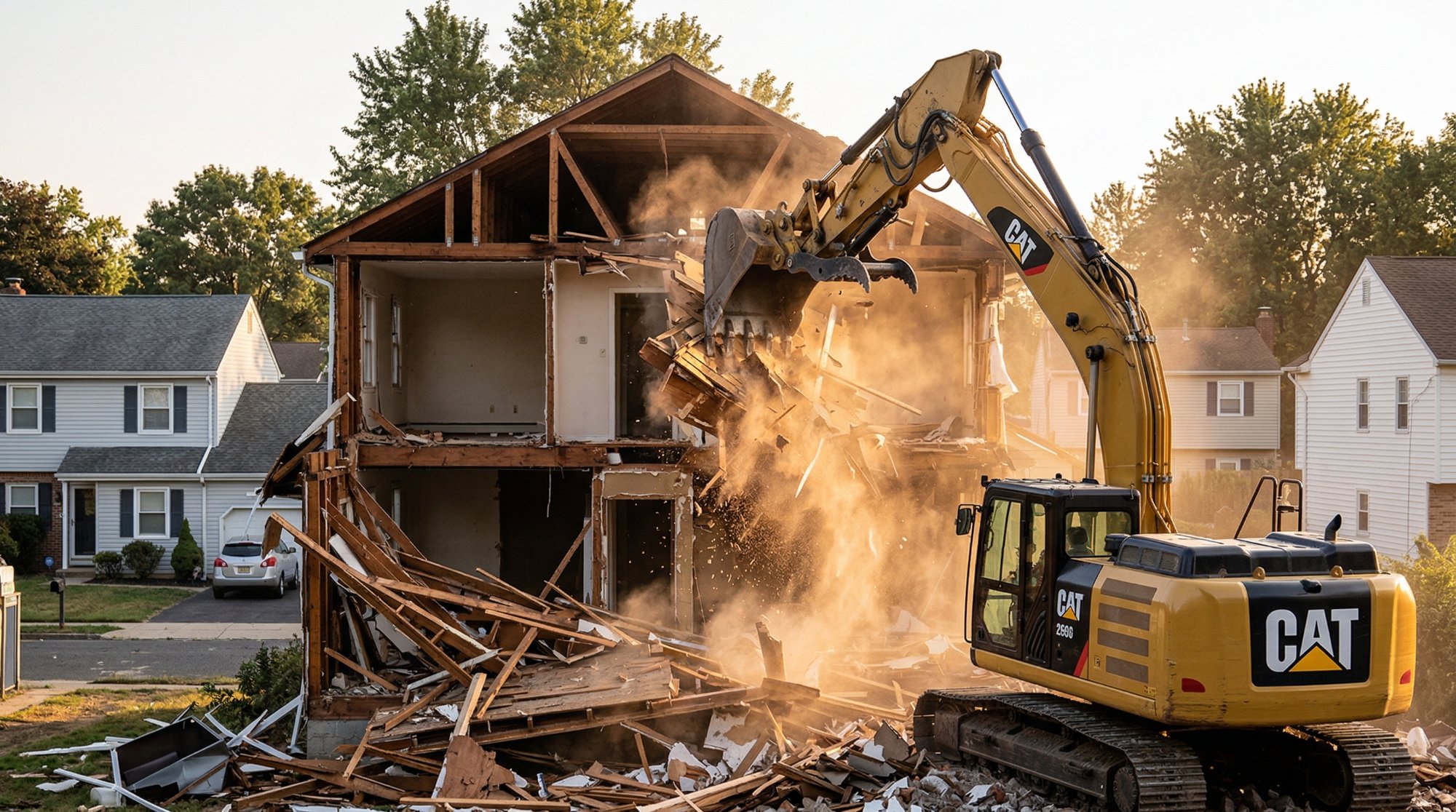
- Mechanical demolition with excavator equipped for tear-down
- Sort debris if recycling is part of the scope (concrete, metal, wood)
- Load and haul to approved disposal facilities (you need disposal receipts for closeout)
- Remove foundation if part of scope (often is for full house demos)
- Backfill and rough grade the site
Step 6: Final Inspection and Closeout
- Building inspector verifies demolition complete and site is properly graded
- Disposal receipts submitted to construction office
- Permit closed out
- Tax assessor notified to update property records
Common Mistakes Homeowners Make
- Starting demolition before permits. Stop-work orders, fines, and required restoration are real consequences.
- Skipping asbestos testing. Improperly handled asbestos creates serious liability and health hazards. EPA and state penalties are significant.
- Not coordinating utility disconnects early enough. 2–4 week lead times are common. Don't schedule the demo until disconnects are confirmed.
- Assuming residential demo is simple. Pool demolitions in particular have specific requirements (proper backfill in lifts, compaction, drainage), and they're done badly all the time.
- Hiring uninsured contractors. If something goes wrong during demolition (neighbor's fence damaged, worker injured, utility hit), you need contractor insurance to protect you. Verify it.
- Using "junk removal" services for structural demo. They're not licensed for demolition and won't pass inspection.
What Demolition Costs in NJ
- Sheds and small accessory structures: $1,500–$5,000
- Detached garages: $4,000–$10,000
- In-ground pools (with proper backfill): $6,000–$15,000
- Single-story houses (full demo, foundation included): $15,000–$30,000
- Two-story houses: $20,000–$45,000+
- With asbestos abatement: add $5,000–$25,000+ depending on extent
For full pricing context across services, see our complete excavation cost guide →
How Mannino Handles Demolition
We handle the full scope — permit coordination, utility coordination, asbestos coordination (we work with certified abatement contractors when needed), the actual demo, debris hauling to approved facilities, foundation removal, and final grading. Single point of accountability, owner on-site, all paperwork handled correctly.
Demolition projects across Jackson, Howell, Old Bridge, Toms River, and the rest of Central NJ. Free on-site estimates. Call (908) 670-7297.