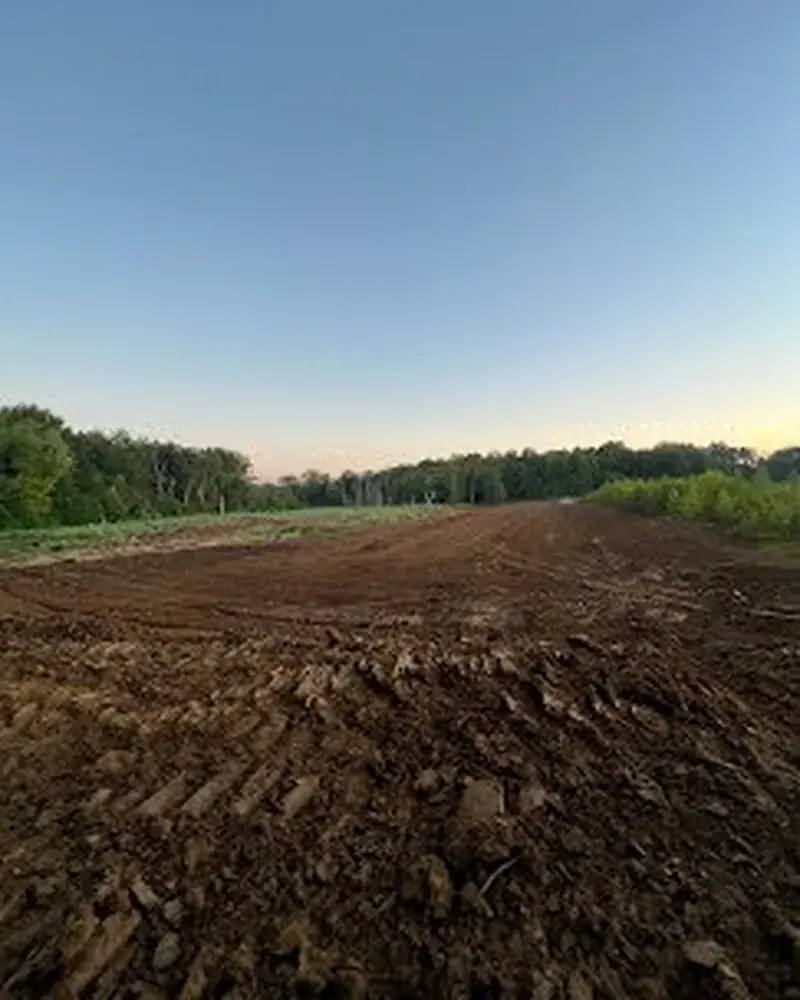
A Pad Isn't Just a Slab
Residential driveways and commercial equipment pads look similar on the surface — they're both flat concrete. But the engineering underneath is completely different. A driveway holds passenger vehicles. A commercial pad holds dump trucks, forklifts, heavy equipment, and the concentrated loads of a working business. Get the specs wrong and it cracks in the first year.
What Goes Under the Concrete
The concrete you see is the top layer of a three-part system:
Subgrade. The native soil, compacted to specification. If the existing soil is soft, expansive, or inconsistent, it gets excavated and replaced with structural fill — typically crushed stone or process gravel. The subgrade carries the load. If it's not right, nothing above it matters.
Base course. Usually 4-8 inches of compacted gravel (3/4" crushed stone or recycled concrete aggregate). This distributes the load from the slab to the subgrade and provides drainage so water doesn't pool under the concrete and cause frost heave.
The slab. Commercial pads are typically 6-8 inches thick (vs. 4 inches for residential driveways). Reinforced with rebar or welded wire fabric, and poured with 4,000+ PSI concrete.
Thickness and Reinforcement — The Real Conversation
For a mechanic's garage or equipment yard, the standard is 6-inch minimum with #4 rebar on 18-inch centers both ways. For heavy equipment (track loaders, dump trucks), go to 8 inches with #5 rebar on 12-inch centers. The extra thickness and reinforcement cost maybe 15-20% more than a 4-inch residential slab, but the cost of replacing a cracked commercial pad is five times the cost of doing it right the first time.
Fiber mesh (the synthetic fibers mixed into the concrete) helps with surface cracking but is not a substitute for steel reinforcement. Use both.
Drainage Matters
A commercial pad needs to shed water, especially if it's in a work area where fluids might spill. The minimum slope is 1% (1/8" per foot) toward a designated drain point. For mechanic shops and wash bays, you may need a containment area with an oil-water separator — check with your town's environmental officer before pouring.
Control Joints
Concrete cracks. That's physics, not a defect. Control joints are where you tell the concrete to crack — saw-cut or tooled lines at regular intervals that create weak points. The concrete cracks along those lines instead of randomly across the surface. For a commercial pad, joints should be spaced at roughly 2-2.5x the slab thickness in feet — so a 6-inch slab gets joints every 12-15 feet.
What We Did for Freedom Auto Group
One of our recent projects was a commercial concrete pad for a mechanic garage. 6-inch slab on compacted gravel base, rebar reinforcement, broom finish for traction, control joints at proper spacing. The pad handles daily vehicle lifts, tire storage, and equipment traffic. The owner's review: "The quality is top-notch and everything was done right the first time."
That's the standard. Right the first time, no callbacks, no cracking.
Get a Quote for Your Commercial Pad
Whether it's a garage, shop, equipment pad, or loading area — call (908) 670-7297 for a free estimate. We'll walk the site, discuss specs, and give you an honest number.