Does Excavation Stop in Winter?
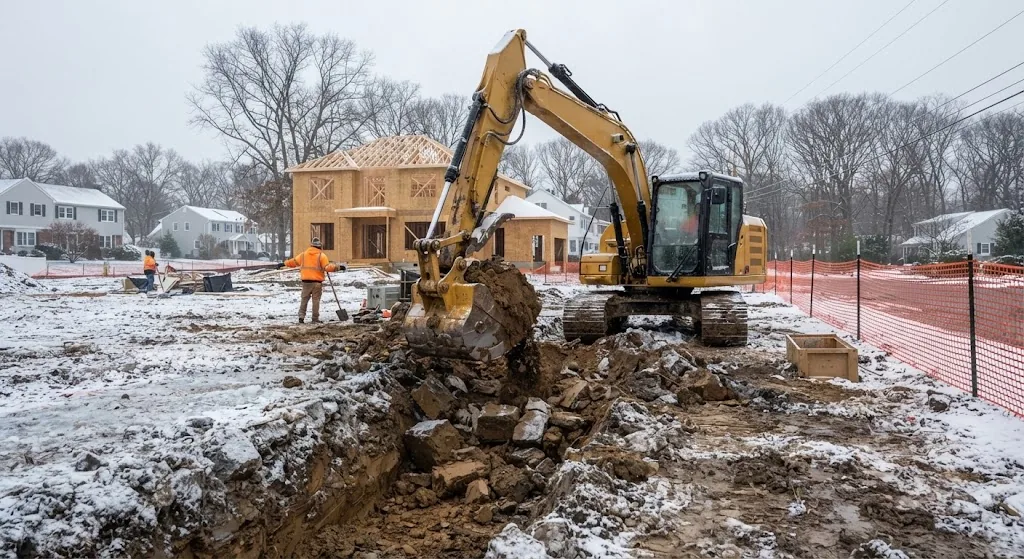
Not in Central NJ. Northern states with deep, long lasting frost do see construction slow to a crawl. Our winters are different. The ground freezes hard during cold snaps, then softens again during thaws, and for much of the season the soil underneath the top layer stays workable. A full size excavator breaks through frozen topsoil on most residential jobs without much trouble.
So the real question is not whether a machine can dig. It is whether the work can be protected once it is dug, and whether the job depends on soil conditions that only exist in spring.
What Frozen Ground Actually Changes
Three things change when the ground freezes:
- Digging takes more effort. The frozen top layer is hard and comes up in chunks. That slows production, and anything that needs hand digging near utilities or foundations gets much harder.
- Frozen soil is not a building surface. Frozen soil holds ice. When it thaws, the ice melts and the soil loses volume, so anything built on it settles. That is why codes do not allow footings or slabs on frozen ground.
- Frozen material is not backfill. Frozen chunks cannot be compacted properly. Backfill placed frozen settles in spring, which shows up as sunken trenches, low spots against foundations, and cracked walkways.
Footings, Foundations, and Frost
Footings in most of New Jersey have to sit at least 36 inches deep to get below frost, which we explain in our footings and frost depth post. Digging to that depth in winter is not the issue. The issue is the bottom of the excavation. If it freezes after it is dug and before concrete goes in, the footing ends up sitting on frozen soil.
Winter foundation work is done all the time, but it is done tightly. The excavation is dug, inspected, and poured with as little delay as possible. The bottom and the fresh concrete are protected with insulated blankets or heat, and concrete is ordered with cold weather mixes. Our how late can you pour concrete post covers the concrete side in detail.
Jobs That Work Well in Winter
- Utility trenches. Water, sewer, and electric runs are a classic winter job, as long as backfill is unfrozen and properly compacted. NJ One Call works year round, so mark outs are still required. See our utility locates post.
- Emergency repairs. A failed septic line, a collapsed drain, or a broken water service does not wait for spring, and these get done in any weather.
- Land clearing and tree work. With leaves down and the ground firm, clearing can actually go easier in winter, and machines do less damage to frozen ground than to mud.
- Early digging for spring builds. Getting a foundation hole or site work done in late winter puts a project ahead of the spring rush, which is the idea behind our spring build timeline post.
Jobs That Are Smarter to Hold for Spring
- Finish grading. Grading needs soil that can be shaped and compacted. Frozen or saturated soil cannot be finished properly.
- Topsoil and seed. Seed needs warm soil to germinate, and topsoil spread on frozen ground does not bond to what is underneath.
- Most drainage regrading. Getting the pitch right on a yard depends on working the surface, which is a spring job.
- Anything during the thaw. The weeks right after the deep thaw are often the worst of the year. Soil is saturated, machines rut lawns, and nothing compacts. A few dry weeks fixes that.
Protecting a Site Through Winter
Any open excavation in winter needs a plan for freezing, water, and safety. That means covering or insulating bottoms that cannot freeze, keeping water out of open holes, stockpiling backfill where it will not freeze solid, and stabilizing the site before the next storm. If your project is stopping for the season instead, our winterizing an unfinished site post covers what to do.
Talk to Mannino About Your Winter Project
Mannino Excavation works year round across Monmouth, Middlesex, and Ocean counties. If you are not sure whether your project fits the winter calendar or should wait for spring, call (908) 670-7297. We will tell you honestly which one makes sense, and if it is spring, we can get you on the schedule now. You can also see our excavation and foundations services.
Frequently Asked Questions
Can you dig when the ground is frozen in NJ?
Usually, yes. In a typical Central NJ winter, frost freezes the top layer of soil but not deep into the ground, and a full size excavator can break through it. Frozen ground takes more effort and time, and hand digging becomes very hard. The bigger question is not whether you can dig, but whether what goes in the hole can be protected from freezing.
Can footings be poured on frozen ground?
No. Footings and slabs must bear on undisturbed soil that is not frozen. Frozen soil holds ice, and when it thaws the ice melts, the soil loses volume, and whatever is on top settles or cracks. In winter that means digging, inspecting, and pouring quickly, then protecting the excavation and the fresh concrete from frost with blankets or heat.
What excavation jobs can be done in winter?
Utility trenches for water, sewer, and electric, emergency repairs like a failed septic line or a collapsed drain, land clearing and tree removal, and early excavation for spring builds all work well in winter. Jobs that depend on soft, dry soil, like finish grading, topsoil, and seeding, are better held until spring.
Is winter excavation more expensive?
It can be, depending on the job. Frozen ground slows digging, and some work needs extra steps like frost blankets, heated enclosures, or hauling in unfrozen fill for backfill. On the other hand, winter is a slower season for many contractors, so scheduling is often easier. The cost difference is project specific, so it is worth getting a quote both ways.
When does the ground thaw in Central NJ?
There is no single date. Central NJ ground freezes and thaws repeatedly through the winter, and the deep thaw usually comes in March. The weeks right after the thaw are often the hardest time to work, because the soil is saturated and soft. Ground firms up again as it dries out, usually by April, depending on rain.